Queens County Real Estate Market Update for June 2026: What Home Sellers Need to Know
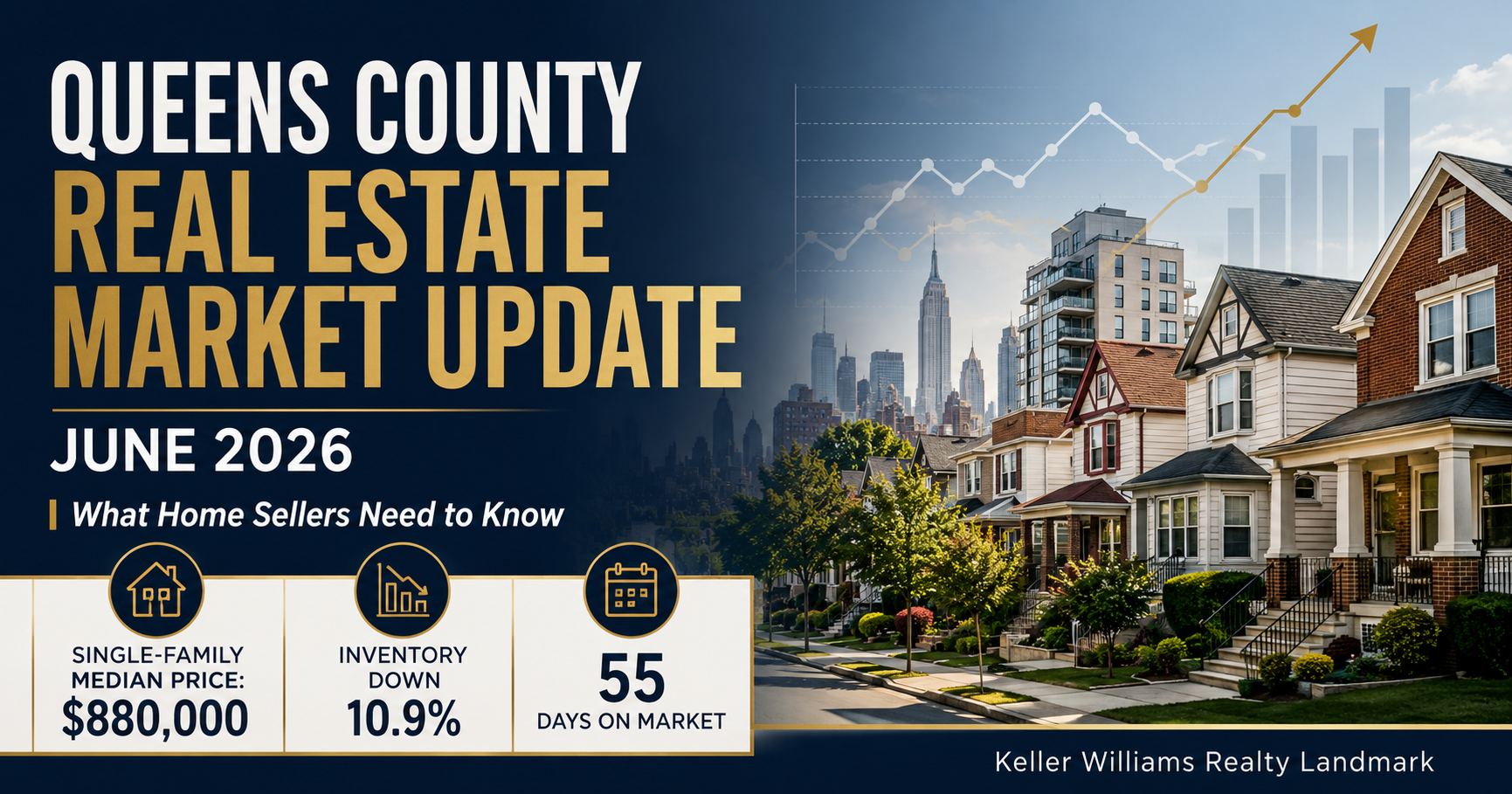
The Queens County real estate market in June 2026 is not moving in one uniform direction.
Single-family homes, condominiums and co-ops are each experiencing different changes in inventory, buyer activity, pricing and time on the market. That means Queens homeowners should not base a major selling decision on a national headline, a borough-wide average or an online estimate alone.
The real question is not simply, “Is the Queens market up or down?”
The better question is:
How is the market performing for my specific property type, neighborhood, condition and price range?
According to the June 2026 Queens County Local Market Update provided by OneKey® MLS, single-family home prices remained resilient, condo inventory continued to tighten, and co-op sales activity increased during June. At the same time, buyers remained selective, and sellers did not automatically receive their full original asking prices.
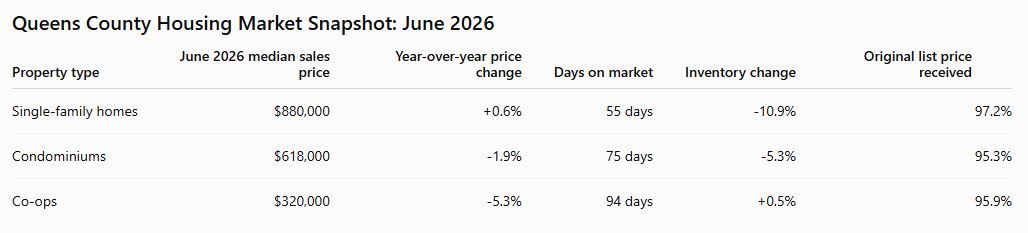
Queens County Housing Market Snapshot: June 2026
One month does not tell the entire story. Looking at the rolling 12-month data, median prices were higher across all three major residential property types:
- Single-family homes increased 4.2%, from $840,000 to $875,000.
- Condominiums increased 6.6%, from $585,000 to $623,400.
- Co-ops increased 3.1%, from $320,000 to $330,000.
The combination of mixed monthly results and positive rolling 12-month appreciation shows why sellers should avoid drawing conclusions from one statistic alone.
What Is Happening With Single-Family Homes in Queens?
Queens single-family homes recorded a median sales price of $880,000 in June 2026, up slightly from $875,000 in June 2025.
New listings increased by 3.6%, but closed sales decreased by 5.1%. Homes also took slightly longer to sell, with days on market increasing from 52 to 55 days.
The most important number for single-family homeowners may be inventory. The number of homes available for sale declined by 10.9%, from 1,409 homes in June 2025 to 1,256 in June 2026.
That limited supply can give properly positioned sellers an advantage. However, limited inventory does not mean every home will sell quickly or at any price. Single-family sellers received 97.2% of their original asking price, indicating that buyers are still negotiating and resisting homes that appear overpriced.
What This Means for Queens House Sellers
A well-maintained home with desirable features such as private parking, outdoor space, an attractive layout, updated mechanical systems or legal income-producing potential may stand out against limited competition.
But sellers should not interpret low inventory as permission to test an unrealistic price.
The strongest strategy is to examine:
- Recently closed comparable homes
- Homes currently under contract
- Active listings competing for the same buyers
- Properties that expired or failed to sell
- Differences in condition, legal use, parking, lot size and location
- Buyer activity within the specific price range
For a deeper explanation of the factors that influence property value, read How Much Is My Home Worth in Queens, NY? What Sellers Need to Know in 2026.
What Is Happening With Queens Condos?
Queens condominiums recorded a median sales price of $618,000 in June 2026, down 1.9% from $630,000 one year earlier.
That monthly decline does not necessarily mean every Queens condo lost value. The rolling 12-month median increased by 6.6%, reaching $623,400. Monthly median prices can change based on the size, location and price level of the units that happened to close during that particular period.
Condos also sold faster. Days on market declined from 82 to 75 days, while available inventory fell by 5.3%.
Over the rolling 12-month period, condo inventory was down 10.9%, closed sales increased 2.4%, and days on market decreased 11.3%.
What This Means for Queens Condo Sellers
The condo market is showing signs of active demand, but buyers still care heavily about value.
A Queens condo seller should be prepared to address:
- Monthly common charges
- Property taxes
- Building amenities
- Parking availability
- Assessment history
- Building financial condition
- Financing restrictions
- Unit condition and renovation level
- Competing developments or resale units
- Proximity to transportation
Queens condo sellers received 95.3% of their original asking prices in June. That gap makes strategic pricing especially important. Starting too high can cause a listing to accumulate market time while better-positioned competing units attract the strongest buyers.
What Is Happening With Queens Co-ops?
The Queens co-op market produced one of the most interesting sets of numbers in June.
Closed sales increased by 12.2%, rising from 205 sales in June 2025 to 230 sales in June 2026. New listings increased by 8.2%, while days on market remained unchanged at 94 days.
The June median co-op price declined from $338,000 to $320,000. However, the rolling 12-month median increased by 3.1%, reaching $330,000. Co-op inventory was also 3.5% higher over the rolling 12-month period.
What This Means for Queens Co-op Sellers
Buyers are purchasing Queens co-ops, but sellers face more competition and a longer average marketing period than single-family homeowners and condo sellers.
A co-op’s marketability can be influenced by more than the apartment itself. Buyers may also evaluate:
- Monthly maintenance
- Building financials
- Board requirements
- Minimum down-payment rules
- Debt-to-income restrictions
- Subletting policies
- Flip taxes
- Assessments
- Amenities
- Building condition
- Transportation access
- The condition of competing apartments in the same development
Professional photography, proper staging, accurate pricing and a clear explanation of the building’s financial requirements can help prevent unqualified buyers from wasting valuable marketing time.
Are Queens Home Prices Going Down in 2026?
There is no honest one-word answer for every Queens property.
The June results were mixed:
- Single-family median prices increased 0.6%.
- Condo median prices declined 1.9%.
- Co-op median prices declined 5.3%.
However, the rolling 12-month median increased for every property type:
- Single-family homes: +4.2%
- Condos: +6.6%
- Co-ops: +3.1%
This does not look like a simple borough-wide collapse in home values. It looks like a segmented market in which property type, neighborhood, condition and pricing strategy matter significantly.
A monthly median decline may reflect a greater number of lower-priced properties closing rather than a uniform decline in the value of every property. Homeowners should therefore avoid applying a borough-wide percentage directly to their own home.
Your home’s potential value should be based on comparable properties that buyers would realistically consider as alternatives.
Thinking about selling? Request a free Queens home value and equity review before making decisions based on an automated estimate or a neighbor’s sale.
Is Now a Good Time to Sell a House in Queens?
For some Queens homeowners, yes—but only with a clear strategy.
June’s single-family inventory was nearly 11% lower than one year earlier, while the median sales price remained close to $880,000. That can create an opportunity for sellers whose homes are properly prepared, marketed and priced.
However, the data also shows that:
- Single-family closed sales declined.
- Single-family days on market increased.
- Sellers received less than 100% of their original asking price.
- Condo and co-op sellers faced even wider gaps between original asking prices and final sales prices.
The market is rewarding realistic sellers, not reckless ones.
Selling now may make sense when:
- You have substantial equity.
- Your current home no longer fits your needs.
- You are downsizing, relocating or retiring.
- You inherited a property you do not want to maintain.
- You own a rental property that no longer supports your goals.
- You have already identified your next move.
- The cost of waiting outweighs the potential benefit.
- Your property has limited direct competition.
Waiting may make sense when:
- You do not yet understand your likely net proceeds.
- Property records, permits or violations need attention.
- Tenant or lease issues require legal guidance.
- You need time to prepare the property.
- You do not have a plan for where you will go after the sale.
- Selling now would create unnecessary financial pressure.
For additional guidance, read Thinking About Selling in Queens, Brooklyn, or Long Island? Here’s What 2026 Is Showing Us.
How Long Does It Take to Sell a Home in Queens?
Based on the June 2026 OneKey MLS report, the market-time benchmarks were:
- 55 days for single-family homes
- 75 days for condominiums
- 94 days for co-ops
These are market-wide statistics, not guarantees. A particular home may sell faster or take substantially longer depending on price, condition, neighborhood, property type, marketing exposure and buyer response.
Sellers should also remember that days on market does not represent the entire moving timeline. Before a property reaches the market, a seller may need time for:
- Repairs and preparation
- Decluttering or moving excess belongings
- Professional photography
- Reviewing property records
- Gathering financial or building documents
- Preparing leases and rent rolls
- Establishing a pricing and marketing plan
After an offer is accepted, the transaction may still need to proceed through attorney review, inspection, appraisal, financing, title work, board approval when applicable and closing.
A homeowner planning to move within the next three to six months should begin preparing before the desired listing date—not after the property is already supposed to be on the market.
How Much Will You Actually Keep After Selling?
The sales price is not the same as the amount a seller receives at closing.
Your estimated net proceeds may be affected by:
- Mortgage and home-equity loan payoffs
- Brokerage compensation
- New York transfer taxes
- Attorney fees
- Property tax adjustments
- Building or association charges
- Co-op flip taxes
- Repairs or buyer credits
- Moving expenses
- Open permits, liens or violations
- Other property-specific expenses
Before deciding whether a sale supports your next move, review How Much Does It Cost to Sell a Home in Queens—and What Will You Actually Net?.
A personalized seller net sheet can help you compare different possible sales prices and understand how much money may remain after estimated expenses.
Selling a Tenant-Occupied Queens Property?
Owners of two-family homes, three-family homes, four-family properties and other rental properties have additional issues to address.
Your strategy may depend on:
- Existing lease terms
- Current rental income
- Security deposits
- Tenant cooperation
- Showing access
- Legal property use
- Rent-regulation status
- Open permits or violations
- Whether a unit will be delivered vacant
- The type of buyer most likely to purchase the property
Questions involving tenant rights, rent regulation, leases or vacancy should also be reviewed with the appropriate New York attorney or housing professional.
Five Steps Queens Home Sellers Should Take Now
1. Request a Property-Specific Market Analysis
Do not rely on the Queens median price alone. Compare your property with homes of the same type, neighborhood, condition, legal use and approximate price range.
2. Review Your Competition
The homes currently for sale are competing for the same buyers. Your pricing and presentation should make sense beside those alternatives.
3. Identify Problems Before Buyers Do
Review property records, permits, violations, building documents, leases and major maintenance concerns before the home is under contract.
4. Calculate Your Estimated Net Proceeds
Know what you may walk away with—not merely what the home might sell for.
5. Build the Sale Around Your Next Move
Selling is not the final objective. Your equity should help accomplish something: purchasing another home, downsizing, relocating, retiring, investing or simplifying your responsibilities.
Get a Queens Home-Selling Strategy Built Around Your Property
The June 2026 Queens real estate market continues to create opportunities for homeowners, but those opportunities differ significantly between houses, condos and co-ops.
A successful seller needs more than a borough-wide median price. You need to understand:
- What your property may realistically sell for
- Which buyers are most likely to purchase it
- How much competition you will face
- What preparation may improve the outcome
- How long the process may take
- What expenses may reduce your proceeds
- How the sale supports your next move
Keller Williams Realty Landmark can connect you with a local real estate professional who understands the Queens market and can help you create a property-specific pricing, preparation and marketing plan.
Ready to Learn What Your Queens Property Could Sell For?
Request your free home value and equity review, or connect with Keller Williams Realty Landmark for a seller consultation.
Do not let an online estimate, a broad headline or an unrealistic asking price determine one of your largest financial decisions.
Get the numbers. Understand your options. Then build the right plan.
*Market data source: OneKey® MLS Queens County Local Market Update for June 2026. Report current as of July 8, 2026. Market statistics are historical and do not guarantee the value, marketing time or future sale price of any individual property.
This article is provided for general informational purposes and is not legal, tax, financial or appraisal advice. Homeowners should consult the appropriate licensed professionals regarding their individual circumstances.